Tuesday, 17 May 2016

10 INTERESTING FACTS ABOUT MARS


 Mars is a constant point of discussion for space explorers around the world. We’ve sent dozens of spacecraft there to study it. Some want to land astronauts on it. The planet is just far away to make that dream difficult, but just close enough to spark our imagination. So what are some of the most important things to learn about the Red Planet?

1. Mars Had Water In The Ancient Past:

We’ve been debating for centuries about whether Mars had life or not. In fact, the astronomer Percival Lowell misinterpreted observations of “canali” — the Italian word for channels — on the planet as evidence of alien-made canals. It turned out Lowell’s observations were hampered by poor telescope optics of his day, and the canals he saw were optical illusions. That said, several spacecraft have spotted other signs of ancient water — channels grooved in the terrain and rocks that only could have formed in the presence of water, for example.

2. Mars Has Frozen Water Today:

We’re very interested in the question of water because it implies habitability; simply put, life as we know it is more likely to exist with water there. In fact, the Curiosity rover’s mandate on Mars right now is to search for habitable environments (in the past or present). Mars has a thin atmosphere that does not allow water to flow or remain in large quantities on the surface, but we know for sure that there is ice at the poles — and possibly frosty locations elsewhere on the planet. The question is if the ice is capable of melting enough water in the summer long enough to support any microbes.
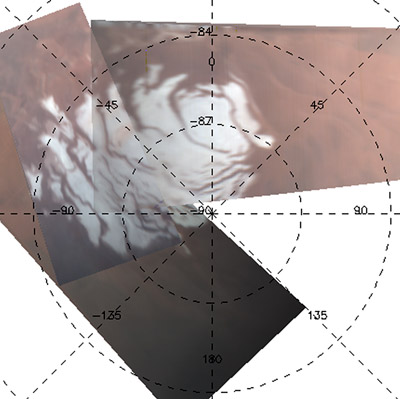
Mars Express Data from Mars South Pole. Credits: ESA/ Image Courtesy of F. Altieri (IFSI-INAF) and the OMEGA team

3. Mars Used To Have A Thicker Atmosphere:

For water to flow in the past, the Red Planet needs more atmosphere. So something must have changed in the past few billion years. What? It is thought that the Sun’s energy striking the atmosphere must have “stripped” the lighter forms of hydrogen from the top, scattering the molecules into space. Over long periods of time, this would lessen the amount of atmosphere near Mars. This question is being investigated in more detail with NASA’sMars Atmosphere and Volatile EvolutioN (MAVEN) spacecraft.

4. Mars Has Some Extreme Highs And Lows In Terrain:

The surface gravity of Mars is only 37% of what you would find on Earth, which makes it possible for volcanoes to be taller without collapsing. This is why we have Olympus Mons, the tallest volcano known on a planet in the Solar System. It’s 16 miles (25 kilometers) high and its diameter is approximately the same as the state of Arizona, according to NASA. But Mars also has a deep and wide canyon known as Valles Marineris, after the spacecraft (Mariner 9) that discovered it. In some parts, the canyon is 4 miles (7 kilometers) deep. According to NASA, the valley is as wide as the United States and is about 20% of the Red Planet’s diameter.
Valles Marineris as seen in this mosaic of Viking orbiter images. Noctis Labyrinthus at the left, Melas Chasma in the middle, Hebes Chasma just left of top center, Eos Chasma at lower right and Ganges Chasma just above center right. Credit: NASA/JPL
5. Mars Has Two Moons – And One Of Them Is Doomed:
The planet has two asteroid-like moons called Phobos and Deimos. Because they have compositions that are similar to asteroids found elsewhere in the Solar System, according to NASA, most scientists believe the Red Planet’s gravity snatched the moons long ago and forced them into orbit. But in the life of the Solar System, Phobos has a pretty short lifetime. In about 30 million to 50 million years, Phobos is going to crash into Mars’ surface or rip apart because the tidal force of the planet will prove too much to resist.

6. We Have Pieces Of Mars On Earth:

Remember the low gravity on Mars that we talked about? In the past, the planet has been hit by large asteroids — just like Earth. Most of the debris fell back on the planet, but some of it was ejected into space. That sparked an incredible journey where the debris moved around the Solar System and in some cases, landed on Earth. The technical name for these meteorites is called SNC (Shergottites, Nakhlites, Chassignites — types of geologic composition). Gases trapped in some of these meteorites has been practically identical to what NASA’s Viking landers sampled on the Red Planet in the 1970s and 1980s.
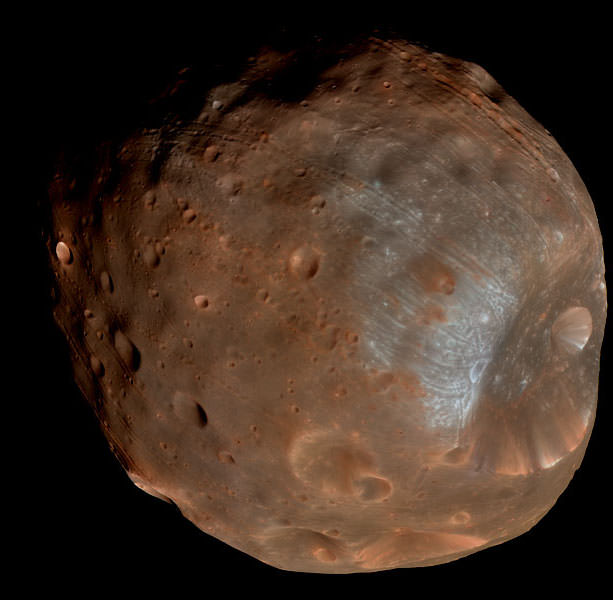
Phobos, the larger of Mars' two moons, with the Stickney crater seen on the right side. Credit: HiRISE, MRO, LPL (U. Arizona), NASA
Phobos, the larger of Mars’ two moons, with the Stickney crater seen on the right side. Credit: HiRISE, MRO, LPL (U. Arizona), NASA

7. Mars Would Kill An Unprotected Astronaut Quickly:

There are a lot of unpleasant scenarios for somebody who took of their helmet. First, Mars is usually pretty cold; its average temperature is -50 degrees Fahrenheit (-45 degrees Celsius) at the mid-latitudes. Second, it has practically no atmosphere. The air pressure on Mars is only 1% of what we have (on average) on the Earth’s surface. And third, even if it did have atmosphere, the composition is not compatible with the nitrogen-oxygen mix humans require. Specifically, Mars has about 95% carbon dioxide, 3% nitrogen, 1.6% argon and a few other elements in its atmosphere.

8. In The Early Space Age, We Thought Mars Was Like The Moon:

The early NASA probes that flew by the Red Planet all, coincidentally, happened to image spots on the planets that had craters. This led some scientists to (mistakenly) believe that Mars has an environment similar to the moon: cratered and practically unchanging. This all changed when Mariner 9 arrived at the planet for an orbital mission in November 1971 and discovered the planet engulfed in a global dust storm. What’s more, odd features were poking out above the dust — features that turned out to be dormant volcanoes. And as mentioned earlier, Mariner 9 found the vast Valles Marineris. It changed our view of the planet forever.
Top: Map of methane concentrations in Autumn (first martian year observed). Peak emissions fall over Tharsis (home to the Solar System's largest volcano, Olympus Mons), the Arabia Terrae plains and the Elysium region, also the site of volcanos. Bottom: True colour map of Mars. Credit: NASA/Università del Salento
9. Mars Has Methane In Its Atmosphere:
Methane can be interpreted as a sign of biological activity — microbes emit it — or even of geologic activity. And active planets, it is thought, are more likely to have life on them. So the question of methane on Mars is one that scientists are trying to figure out. The consensus? There is no consensus. Telescopic observations have had wildly different measurements over the years, and few spacecraft have been designed to probe for the element in detail. The Curiosity rover has detected tenfold spikes in methane in its area, but we don’t know where it came from and why the fluctuations are happening.

10. Mars Is A Popular Spacecraft Destination:

There have been so many spacecraft that attempted a Martian mission that it’s hard to pick notable ones in a short article. NASA’s Vikings were the first landers in 1976; in fact, NASA is the only agency that has managed to land on the planet so far. Some of its other missions include Pathfinder-Sojourner (the first lander-rover combination) in 1997, the Mars Exploration Rovers Spirit and Opportunity in 2004, and the Curiosity rover of 2012. And this doesn’t even mention the fleet of orbiters that have mapped Mars over the years from the Soviet Union, NASA, the European Space Agency and India. And there are many more spacecraft to come in the next decade.

courtesy by : www,universetoday.com

Wednesday, 11 May 2016

25 Things You Didn’t Know About The Movie "Titanic"

1. The studio wanted Tom Cruise to play the role of Jack Dawson.

20th Century Fox / sooziq.com
Warner Bros. Pictures / filmfanatic.org
20th Century Fox wanted both Brad Pitt and Tom Cruise for the lead, but James Cameron insisted on Leo DiCaprio.

2. If all of the present day scenes were deleted, leaving only the scenes that take place in 1912, the film would run 2 hours and 40 minutes, the exact time it took for the Titanic to sink.

20th Century Fox / Via gifstumblr.com

3. Jack and Rose’s spitting scene was almost entirely ad-libbed, as was the moment when Kate Winslet spat in Billy Zane’s face.

20th Century Fox / Via fanforum.com
Rather than spitting on Billy Zane’s face, Kate Winslet’s character was supposed to stick him with a hairpin.

4. After writing the fictitious character of Jack Dawson, James Cameron learned that there was a real J. Dawson who died on the Titanic.

After writing the fictitious character of Jack Dawson, James Cameron learned that there was a real J. Dawson who died on the Titanic.
20th Century Fox / Via tasteofcinema.com
Joseph Dawson, along with many other Titanic victims, was buried in a cemetery in Nova Scotia. His gravestone is apparently the most visited in the cemetery.

5. This is the second film that features the sinking of the Titanic to win the Best Picture Oscar.

This is the second film that features the sinking of the Titanic to win the Best Picture Oscar.
Getty / TIMOTHY A. CLARY
The first was 1933’s Cavalcade.

6. The elderly couple who lie in bed as water floods the room is a tribute to Ida and Isidor Strauss, the owners of the Macy’s department store, who died on the Titanic.

20th Century Fox / Via titanic.tumblr.com
Ida was offered a seat on a lifeboat but turned it down because she wanted to stay with her husband. She is quoted as saying: “As we have lived together, so we shall die together.”

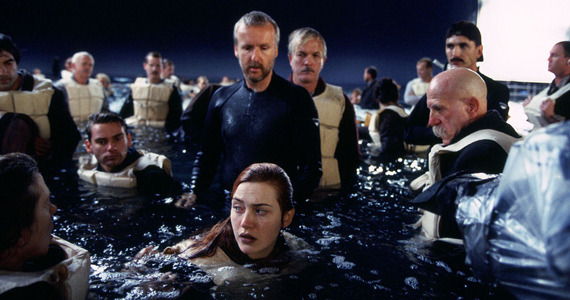
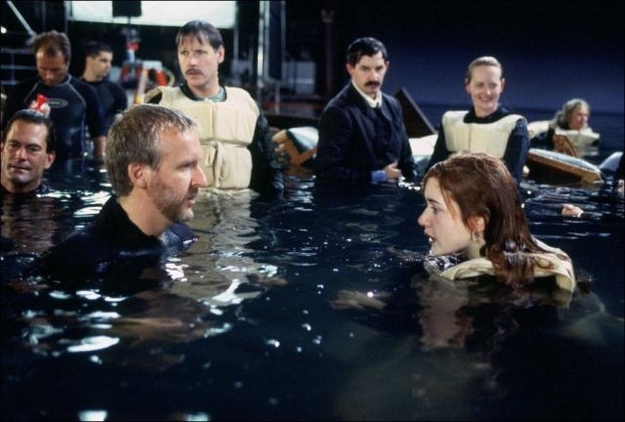
7. Kate Winslet was one of the only people who didn’t wear a wetsuit while filming.

Kate Winslet was one of the only people who didn't wear a wetsuit while filming.
20th Century Fox / Via thecoast.ca
She got pneumonia and almost quit the production.

8. It’s actually James Cameron’s hands that are seen sketching Rose, not Leo Dicaprio’s.

20th Century Fox / Via dawson-rose-dawson.tumblr.com
This image was then mirrored onto the screen, as James Cameron is left-handed but Leo DiCaprio is right-handed.

9. It cost more money to make the movie Titanic than it did to actually construct the original ship.

20th Century Fox / Via dawson-rose-dawson.tumblr.com
Movie’s cost: $200 million.
Ship’s cost: $7.5 million ($150 million when adjusted for inflation).

10. The final dress Kate Winslet wears in the movie is made to look as good wet as it did when dry.

20th Century Fox / fanpop.com
Also, costume designed Deborah Lynn Scott made 24 identical versions of the dress.

11. The line “I’m the king of the world!” was ad-libbed.

The line “I’m the king of the world!" was ad-libbed.
20th Century Fox / Via wittyburg.com
And it’s considered among AFI’s 100 greatest movie quotes of all time.

12. Composer James Horner said that the first cut he saw of the film was 36 hours long.

20th Century Fox / Via fanpop.com
(This is how I imagine James Horner looked after viewing 36 hours of footage.)

13. During the final scene of the movie, when Rose meets Jack at the Grand Staircase, the clock reads 2:20 a.m., which is the exact time the Titanic sank.

20th Century Fox / Via sodahead.com

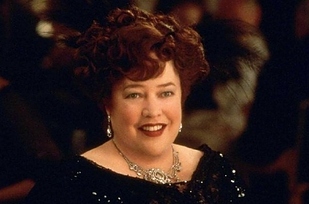
14. Barbra Streisand and Reba McEntire were both in talks to play Molly Brown.

Getty / NBC
Getty / R. Diamond
But the unsinkable character was ultimately played by Kathy Bates.

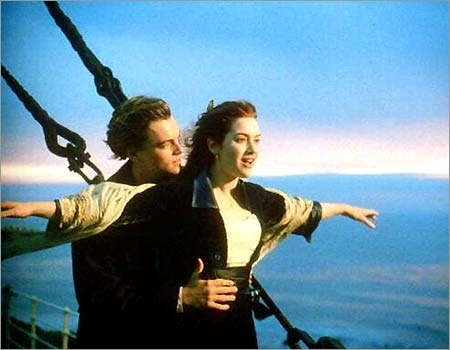
15. Madonna was considered for the role of Rose.

20th Century Fox / out-is-through.blogspot.com
Getty / Tony Barson

16. Titanic was the 10th film that James Cameron directed, but it is only the first that didn’t include the use or mention of nuclear weapons.

Titanic was the 10th film that James Cameron directed, but it is only the first that didn’t include the use or mention of nuclear weapons.
Hemdale Films / Via christopherstarr.wordpress.com

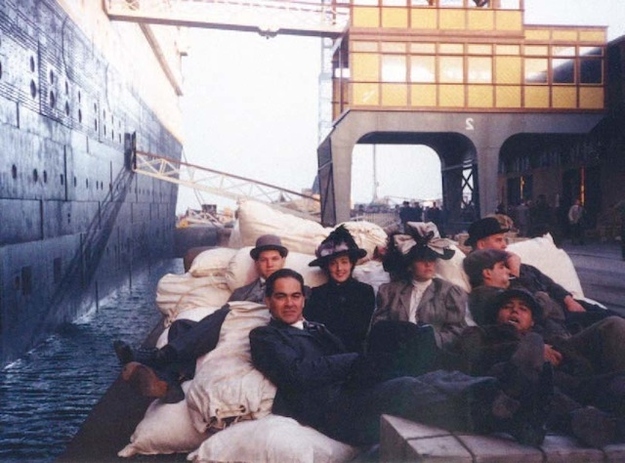
17. Most of the movie’s extras were given a three hourlecture on proper 1912 mannerisms and behavior, so as to give the film a more authentic look.

20th Century Fox / Via feefeern.wordpress.com

18. Gloria Stuart was the only person who worked on the production of the film who was actually alive during the Titanic’s maiden voyage in 1912.

20th Century Fox / Via forum2.winxclub.com
She was born on July 4, 1910.

19. Titanic was the first film to have two people nominated for an Oscar for portraying the same character.

20th Century Fox / altfg.com
20th Century Fox / mediamikes.com
The second film to do so was Iris (2001).

20. Most of the ocean that the actors jump into is just a giant, 3-feet-deep pool.

Most of the ocean that the actors jump into is just a giant, 3-feet-deep pool.
20th Century Fox / Via izismile.com

21. To make the bodies in the water appear frozen, a powder was applied to the actors’ faces, which then crystallized when exposed to water.

To make the bodies in the water appear frozen, a powder was applied to the actors’ faces, which then crystallized when exposed to water.
20th Century Fox / Via ithoughtyouwereshorter.wordpress.com
Wax was also applied to everyone’s hair and clothes, which gave everything a glossy, frozen look.

22. James Cameron provided more than 150 extras with names and backstories of real Titanic passengers.

James Cameron provided more than 150 extras with names and backstories of real Titanic passengers.
20th Century Fox / Via vice.com

23. The entire film contains over 100 speaking parts, with more than 1,000 extras.

20th Century Fox / Via twohartzbloggers.tumblr.com

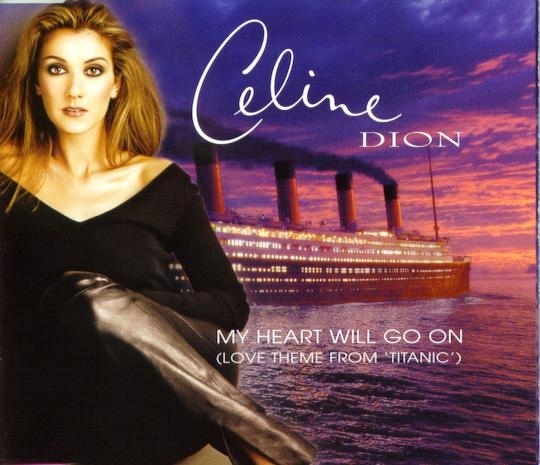
24. Titanic was the first non-musical Best Picture winner to also win the Oscar for Best Original Song.

Titanic was the first non-musical Best Picture winner to also win the Oscar for Best Original Song.
Going My Way (1944) and Gigi (1958) are the only other Best Picture winners to also win the award. Both are musicals.

25. The film was nominated for 14 Academy Awards, the most Oscar nods for any film, ever.

The film was nominated for 14 Academy Awards, the most Oscar nods for any film, ever.
Getty / HECTOR MATA


COURTESY by : BUZZFEED.com